
 UAE
UAE
 Qatar
Qatar
 Pakistan
 KSA
KSA
 Oman
Oman
 Kuwait
 Bahrain
Most dates exporters start by asking which certificate they need. A more useful question is what the buyer expects, what can go wrong in your process, and what evidence shows your controls work. The certificate follows from those answers.
Saudi dates are well known in regional and international markets, but a good product and a fair price are not enough on their own. Buyers increasingly ask for proof that food safety risks are understood, suppliers are controlled, hygiene is consistent, batches can be traced and, where relevant, Halal requirements are managed.
That is why ISO 22000, HACCP and Halal often show up together in one buyer questionnaire or tender. They can look like three competing routes. They are not: each answers a different question, and the controls overlap more than most companies expect.
Three systems, three different jobs
| Area | HACCP | ISO 22000 | Halal assurance |
|---|---|---|---|
| Main purpose | Control food safety hazards | Manage food safety through a structured management system | Show that products and processes meet Halal requirements |
| Main focus | Hazard analysis and control measures | Prerequisite programs, HACCP principles, communication, traceability, improvement | Ingredients, suppliers, processing, handling and Halal evidence |
| Supplier control | Food safety risk from supplied materials | Formal supplier management | Halal status and supporting evidence where relevant |
| Traceability | Supports investigation and recall | Formal system for product and material traceability | Supports material identity and Halal integrity |
| Typical reason to use it | A focused hazard control requirement | A certifiable food safety management system | A buyer or market asks for Halal assurance |
The key relationship is between HACCP and ISO 22000. ISO 22000 already includes the HACCP principles, so it does not add a second hazard control system next to HACCP. A company moving toward ISO 22000 should strengthen and formalize its HACCP-based controls, not start again.
HACCP itself comes from the Codex Alimentarius General Principles of Food Hygiene (CXC 1-1969). Codex keeps good hygiene practices and the HACCP system separate but shows how they work together, and that matters in a dates facility because a HACCP plan cannot make up for weak day-to-day hygiene.
What this looks like in a dates packing operation
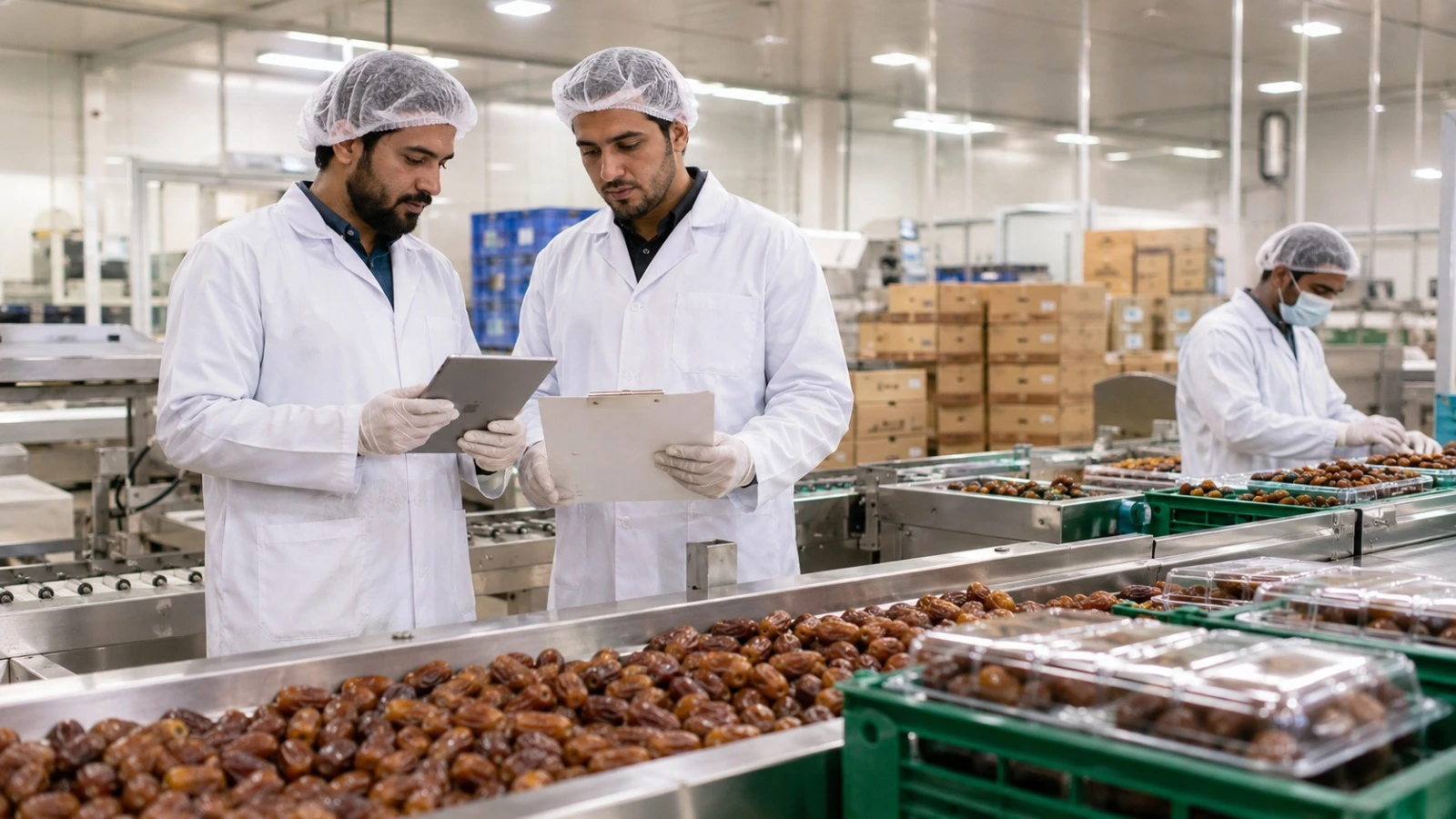
Take a facility that receives dates from several farms. Depending on the product, the dates may be inspected, cleaned, sorted, graded, pitted, filled, coated or packed before storage and dispatch. Some businesses handle plain whole dates. Others make gift boxes or products with chocolate, nuts, dairy, flavorings or other ingredients.
The same records can serve more than one purpose. A supplier approval record supports ISO 22000. Information about incoming materials feeds the HACCP hazard analysis. If a filling has a Halal question, the same supplier file can hold the Halal evidence. A batch code supports recall traceability and also shows which materials went into a Halal-controlled product. One operation with the requirements mapped onto it is better than three folders nobody opens until an audit is announced.
1. Supplier control starts before the dates reach the line
You should know who supplied the dates, what specification was agreed, how incoming lots are identified, what acceptance checks you run, and what documents your buyer needs.
- approved supplier status and periodic review
- specifications for raw materials, ingredients and packaging
- lot, farm or supplier identification where relevant
- receiving inspection and acceptance criteria
- certificates or lab results when risk, specification or the buyer requires them
- supplier performance, complaints and corrective actions
- Halal documentation for ingredients or materials where relevant
Match the level of control to the risk. A supplier of plain harvested dates raises different questions from a supplier of a filling, coating or processing aid. The goal is not the biggest file. It is knowing which evidence matters and why.
2. Traceability should follow the product, not just the invoice
A buyer may ask whether a carton can be traced to a production lot. A good system goes further and links the finished product to the incoming lots, the processing or packing record and the dispatch record. A typical chain runs from supplier or farm, to incoming lot, to packing batch, to finished lot, to storage, to customer dispatch.
This matters more when you handle several varieties, several farms, different pack sizes or value-added products. A batch number only helps if your team can use it quickly, so run a mock recall now and then to find the weak links before a real complaint does.
3. Hygiene and prerequisite programs are the foundation
A common mistake in food safety projects is spending weeks debating critical control points while basic hygiene still varies from shift to shift. The prerequisite programs create the conditions the HACCP study relies on:
- personnel hygiene
- cleaning and sanitation
- pest management
- water quality where water is used in the process
- maintenance and the condition of food-contact surfaces
- chemical, waste and foreign-material controls
- storage, transport and dispatch hygiene
- training and supervision
Two exporters can sell a similar box of dates and still need different controls. One may only sort and pack whole dates, while another washes, pits, fills, coats and wraps them. Their hazard analyses should not be copies of each other.
4. HACCP should match what happens on the floor
A useful HACCP study starts by walking the process, not by opening a template. The team confirms the flow, identifies the biological, chemical and physical hazards, decides which are significant, chooses control measures, and sets how they will be monitored and verified.
For dates, that can include risks from incoming agricultural material, pests, storage, foreign materials, cleaning, packaging, added ingredients and processing steps. Which hazards matter, and which controls are critical, depends on your product and process. Calling every step a critical control point makes the system unworkable. Missing a significant hazard is worse. Involve production staff, because they know about variations, shortcuts and seasonal realities that never make it into a procedure written in an office.
Check the Saudi regulatory position for your own activity. In a 2024 enforcement update, the Saudi Food and Drug Authority (SFDA) described inspections of food establishments under its supervision that included checking whether HACCP and tracking systems exist and work. That is useful context, but confirm the rules that apply to your facility and product rather than assuming one certification route is mandatory for everyone.
5. ISO 22000 adds the management system layer
If HACCP is the engine of food safety, ISO 22000 is the structure around it. It links hazard control to leadership, responsibilities, communication, documented information, supplier management, competence, traceability, emergency arrangements, verification, internal audit, corrective action, management review and improvement.
That structure helps when you deal with larger customers, formal vendor registration, several sites, or buyers who specifically ask for a certified food safety management system.
Before you start a project, confirm which edition of ISO 22000 your certification body will audit against, because a revision of the standard has been in progress. Also remember that ISO writes the standards but does not certify companies. Third-party certification is decided by an independent certification body.
6. Where Halal fits for dates
Plain dates are plant-based, so the Halal side of a simple dates operation can be fairly straightforward. It gets more complicated with chocolate coatings, fillings, dairy, flavorings, glazing agents, processing aids, contract packing or shared equipment.
Halal assurance can involve ingredient and supplier review, supporting certificates, segregation, cleaning, storage, processing and label controls. Its objective differs from HACCP, though some evidence, especially supplier records and traceability, can be shared.
The Saudi Halal Center, part of SFDA, provides Halal certification services. For an exporter, the destination market still decides. Confirm what your buyer or destination market recognizes before paying for a particular route. For support with implementation, see our Halal consultancy in Saudi Arabia page.
One set of evidence, not three
An integrated system should cut duplication. One supplier register can show the product supplied, approval status, food safety risk, required test evidence, Halal documents where relevant, review date and supplier performance. One traceability system can serve food safety investigations, customer complaints and Halal material identification. Systems fail when staff have to choose between several forms that ask for nearly the same information, and shared records are easier to maintain and easier to explain in an audit.
Which route should a dates exporter choose?
There is no one answer. Start with the buyer, the product and the export market, then pick the route.
| Situation | Route to consider |
|---|---|
| Buyer asks for a documented HACCP system | Build and verify HACCP against your actual product and process. |
| Buyer specifically asks for HACCP certification | Confirm the scheme the buyer expects, and that it accepts your certification body, before appointing one. |
| Buyer requires ISO 22000 certification | Implement the full ISO 22000 system and prepare for third-party certification. |
| Buyer or export market asks for Halal evidence | Confirm the accepted Halal scheme, certificate and issuing body before you start. |
| You produce filled or coated dates | Combine food safety controls with ingredient-specific and Halal controls. |
| Different buyers ask for different assurances | Build one integrated system and map each buyer requirement to shared controls and evidence. |
| The buyer requirement is unclear | Get it in writing before spending on certification. |
If HACCP is your route, see our HACCP consultancy in Saudi Arabia page, and for the broader system, our ISO 22000 consultancy page. Our post on how long HACCP certification takes may help with planning.
Questions to ask the buyer first
A short conversation with the buyer can save weeks of work and unnecessary certification cost. Ask:
- Do you require HACCP, ISO 22000, Halal certification, or a combination?
- Do you need third-party certification, or evidence of an implemented system?
- Do you specify a particular certification or accreditation arrangement?
- Which site and which products must be in scope?
- Does the destination country have Halal recognition requirements?
- What supplier certificates, declarations or product specifications must I provide?
- What lab testing or certificates of analysis do you expect?
- What traceability information must appear on the product or documents?
- Are there packaging, labeling or shelf-life requirements?
- Will you require an audit report, a supplier questionnaire or an approval visit?
Common mistakes that look small until an audit
- using a generic HACCP plan that does not match your facility or product flow
- approving suppliers without real supporting evidence
- keeping batch codes that cannot trace material forward and backward
- getting a certificate without checking that the buyer will accept it
- assuming one Halal certificate is accepted by every destination market
- ignoring outsourced storage, transport or contract processing
- not updating the hazard analysis when you launch a filled, coated or value-added product
- treating certification as a substitute for product, labeling or destination-market requirements
Build the system around the export route
Start with the product and the customer. List the products you export, map the suppliers and process steps, understand the hazards, check that your hygiene controls really work, and test your traceability. Then confirm the buyer's food safety and Halal expectations before choosing a certification route. Done properly, ISO 22000, HACCP and Halal share supplier controls, traceability, hygiene records and evidence while still serving their different purposes.
Qdot is a consultancy and training provider. We support Saudi food businesses with gap analysis, system development, implementation, training, internal audit and certification readiness. The certification decision is made by the independent certification body, not by us.
info@qdot-ksa.com | / +966 55 152 2482 / +966 53 349 8921